Many parents use white noise at bedtime and for naps. The thing to watch is volume, because some sound machines get loud enough to worry pediatricians. Here is what the AAP and hospitals advise, and how to set up a phone the safe way.
The short answer
It can be, if you keep it quiet, far from your baby and short. The AAP warns that some sleep machines can reach hazardous noise levels, and Children's National Hospital advises staying below about 50 dB (a soft conversation), at least two feet (about 60 cm) from the crib, and turning it off once your baby is asleep. Never put a phone or speaker in the crib.
What the AAP says about white noise for babies
The American Academy of Pediatrics (AAP) is concerned with how loud white noise gets. On HealthyChildren.org, its site for parents, the AAP says some sleep machines can produce hazardous noise levels. It advises placing the machine as far from your baby's head as possible and using it for a short time.
In 2023 the AAP also published a clinical report on the topic, "Preventing Excessive Noise Exposure in Infants, Children, and Adolescents".
What a study of baby sound machines found about volume
A 2014 study in the journal Pediatrics, by Hugh and colleagues, shows why volume matters. The team tested 14 infant sleep machines at maximum volume.
At 30 cm (about one foot) away, every machine went above 50 dBA. That is the noise limit used for hospital nurseries. Three of the machines went above 85 dBA. The authors advised parents to put the machine farther away, turn the volume down, and use it for a shorter time.
The study tested sleep machines, not phones. We have not measured phone speakers. But a phone at full volume next to a baby raises the same worry, so the same advice makes sense.
How loud should white noise be for a baby?
Children's National Hospital advises keeping the sound below about 50 dB, "similar to a soft conversation". In practice, that is quiet. You should be able to talk softly over it without raising your voice.
Most parents do not own a sound meter. A simple rule helps: start with the volume at its lowest and raise it only until you can just hear it from where your baby lies. If you have a sound level meter app, you can hold the phone where your baby's head will be and check. If the sound seems loud to you from the crib, it is too loud.
How far from the crib should white noise be?
Children's National Hospital advises at least two feet (about 60 cm) between the machine and the crib. The AAP says as far from your baby's head as possible. More distance is better.
Across the room is a good place: on a dresser or a shelf, out of reach. The AAP's safe sleep advice is to keep the crib clear of objects. So a phone, a speaker and any charging cable always stay out of the crib, and out of reach of little hands.
Should white noise play all night or stop once your baby is asleep?
Children's National Hospital advises turning the sound machine off once your baby is asleep. The AAP says to use it for a short time. Neither one suggests leaving it loud all night.
This is where a sleep timer helps. Set it to cover the time it usually takes your baby to settle. Then the sound stops by itself, even if you have fallen asleep too. If you would rather not stop it, turn it down. Keep it low either way.
Quiet, far from the crib, and off once your baby is asleep.
How to use a phone as a baby sound machine safely
A phone can work well as a baby sound machine, as long as you set it up with care. Here are the steps.
- Turn the volume low. Start at the lowest setting and raise it only until you can just hear it near the crib. Aim for quieter than a soft conversation.
- Put the phone across the room. At least about 60 cm (two feet) from the crib, farther if you can. A dresser or shelf works well.
- Never put the phone in the crib. Keep the phone and its cable out of the crib and out of reach.
- Silence calls and alerts. Turn on Do Not Disturb or airplane mode, so a ringtone does not go off near your sleeping baby. If you use airplane mode, play something you have downloaded.
- Use a sleep timer. Let the sound fade out on its own instead of playing all night.
- Turn it off or down once your baby is asleep. If you are still in the room, lower it or stop it.
Does white noise help babies sleep? What the research shows
The evidence is mixed. One early study, by Spencer and colleagues in 1990, followed 40 newborns. With white noise, 80% fell asleep within 5 minutes, against 25% without it. But the study was small and is now old. It is one result, not proof.
More recent reviews are cautious. The Cleveland Clinic points to reviews of 38 studies (2020) and 34 studies (2022) that found limited evidence that noise improves sleep. So white noise may help some babies settle, and not others. If you use it, the volume, distance and timing above matter more than the type of noise.
How Berceuse helps you keep baby white noise quiet, far and short
We make Berceuse, a sleep sounds and music app, and it makes these steps easy to follow with a phone. Its library has more than 900 sounds and music tracks (as of September 2026), including baby white noise, pink and brown noise, womb sounds, shushing and lullabies.
Each sound in a mix has its own volume slider, so you can keep every layer low instead of one loud sound. The sleep timer runs for 5, 10, 15, 30 or 60 minutes and fades the sound out over the last 30 seconds. So the sound stops by itself, even if you have fallen asleep too. Download a mix and it plays with airplane mode on, so no call or alert goes off near the crib. On iPhone (iOS 17 or later), you can say "Stop Berceuse in 30 minutes" from across the room, without walking back to the phone. Berceuse never uses the microphone. It is a subscription with a 3-day free trial.
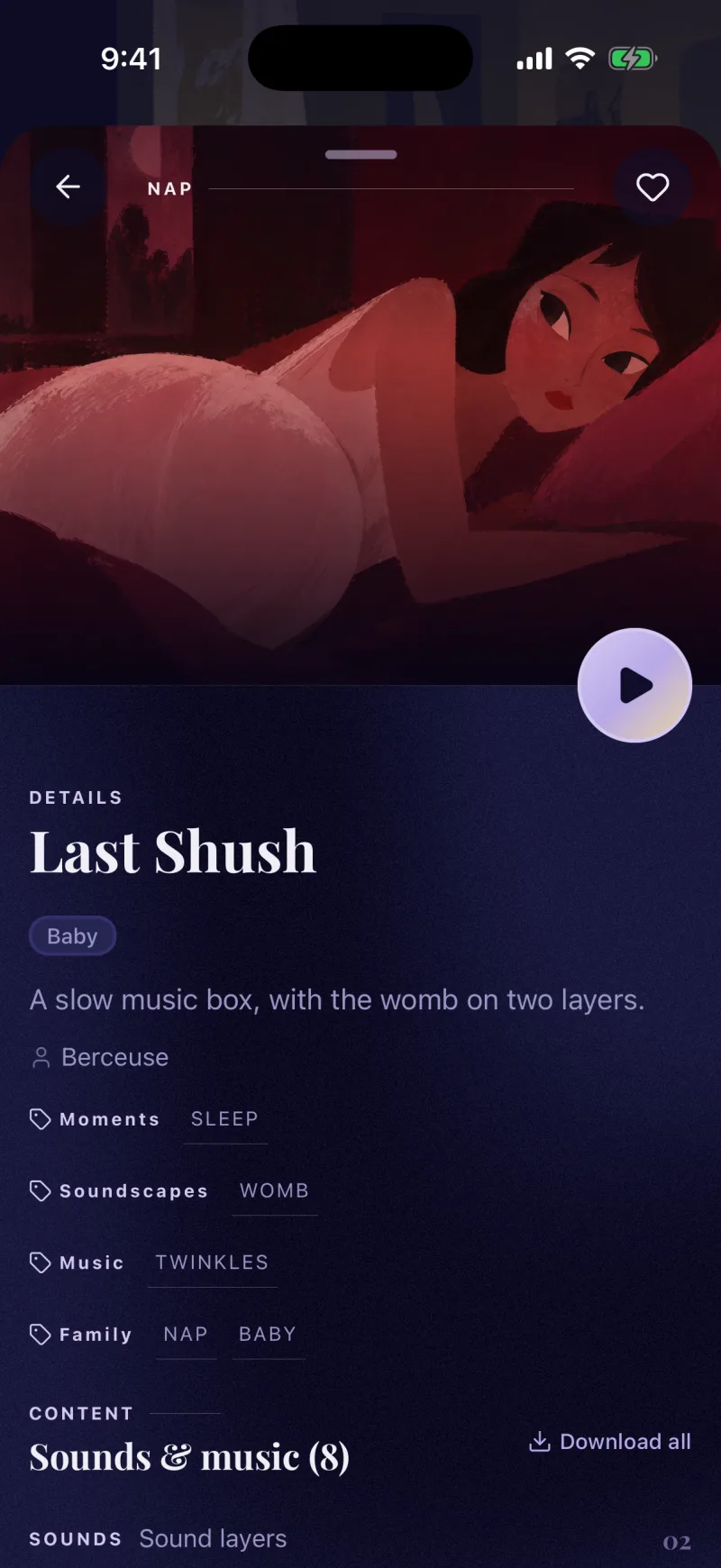
A ready-made nap mix for a baby: music box over womb sounds.
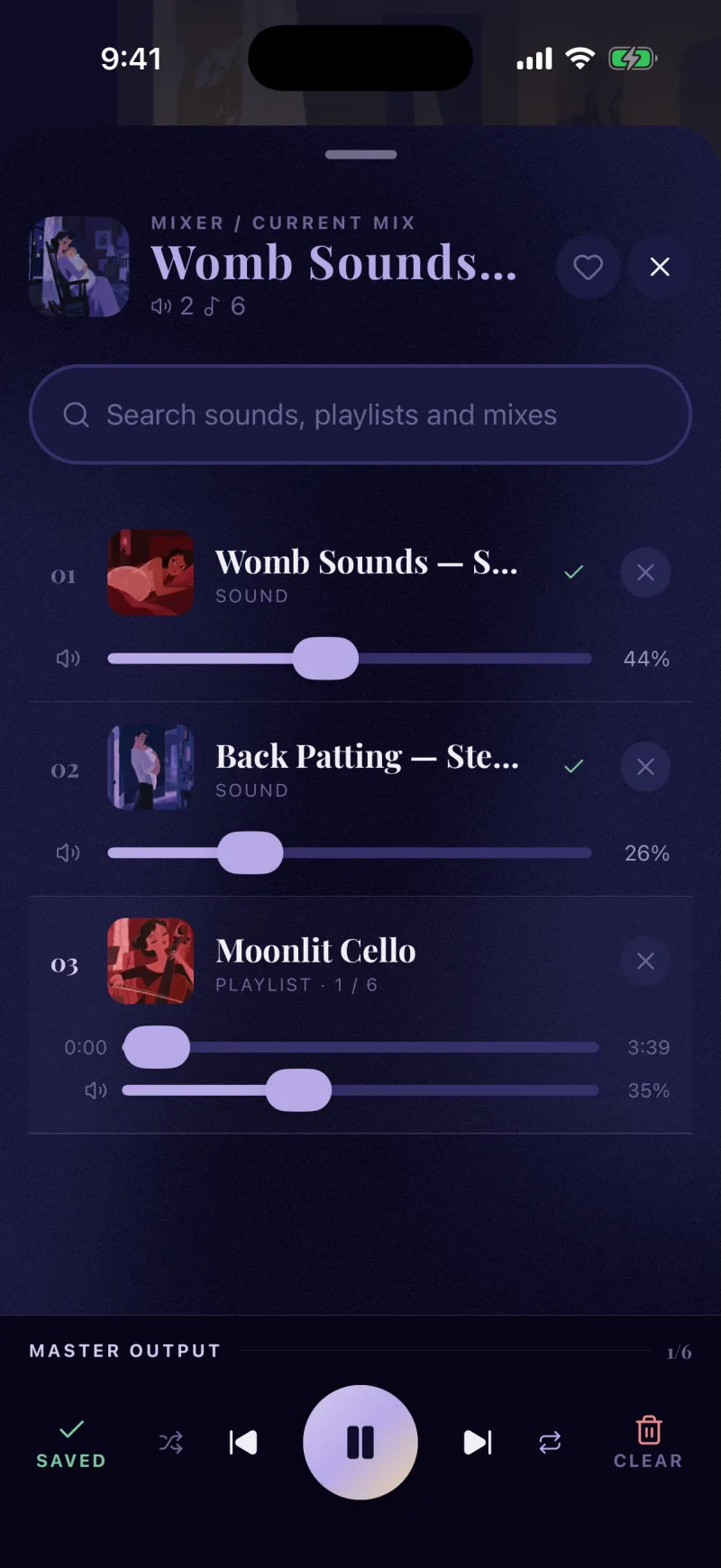
The mixer: each sound has its own volume, with music underneath.
Questions people ask
How loud should white noise be for a baby?
Below about 50 dB, which Children's National Hospital describes as "similar to a soft conversation". Start at the lowest volume and raise it only until you can just hear it near the crib.
How far should a sound machine be from the crib?
At least two feet (about 60 cm), according to Children's National Hospital. The AAP says as far from your baby's head as possible. Across the room is a good spot.
Can I put my phone in the crib to play white noise?
No. The AAP's safe sleep advice is to keep the crib clear of objects. Keep the phone and its cable out of the crib and out of reach.
Should I leave white noise on all night for my baby?
Children's National Hospital advises turning it off once your baby is asleep, and the AAP says to use it for a short time. A sleep timer makes this easy.
Is pink or brown noise safer than white noise for babies?
The guidance is about volume, distance and time, not the color of the noise. Pink and brown noise sound softer and deeper, but they still need to be quiet and far from the crib. Our guide to white, pink and brown noise explains the difference.
Does white noise help babies sleep?
Maybe, for some babies. One small 1990 study of 40 newborns found more fell asleep quickly with white noise. Later reviews found limited evidence that noise improves sleep.
Sources
- AAP, HealthyChildren.org: How noise affects your child
- Hugh et al., Infant sleep machines and hazardous sound pressure levels, Pediatrics 2014
- AAP clinical report: Preventing Excessive Noise Exposure in Infants, Children, and Adolescents, 2023
- Children's National Hospital: Baby sound machines and hearing loss
- AAP, HealthyChildren.org: Preventing SIDS
- Spencer et al., White noise and sleep induction, Archives of Disease in Childhood 1990
- Cleveland Clinic: Brown noise